
The Castle

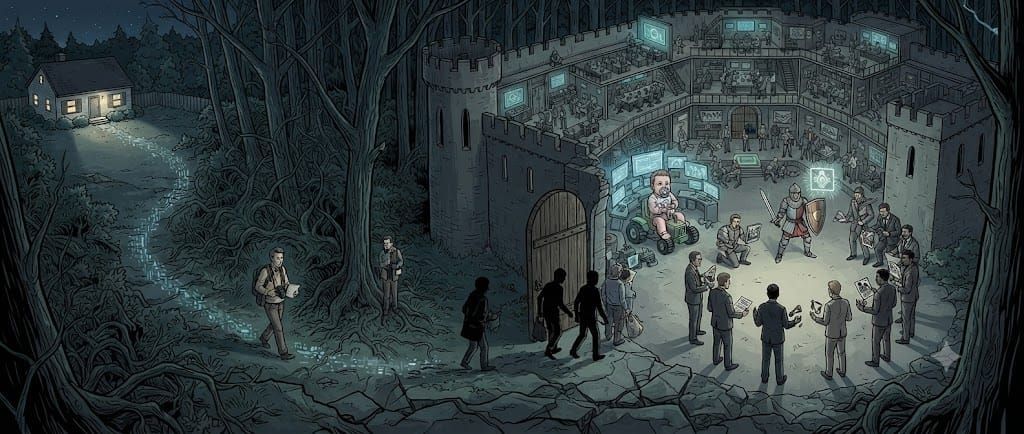
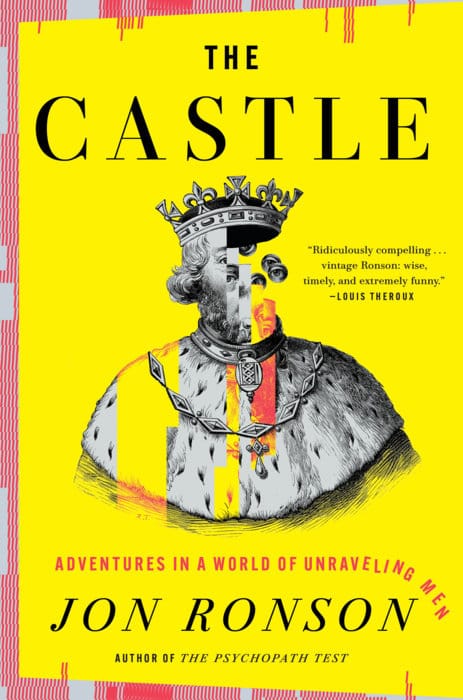
Jon Ronson’s The Castle starts with a premise that feels closer to psychological fiction than traditional journalism: his only child is lured away late at night to an isolated fortress hidden in the forests of New England. That single, terrifying event drags Ronson out of his normal routine and forces him directly into an underground ecosystem of unmoored men who are desperately trying to manufacture their own rules, hierarchies, and sense of authority in a world they feel has left them behind.
Rather than treating the modern conversation around masculinity as a stale talking point or a predictable cable news debate, Ronson investigates how these abstract cultural anxieties actually play out in real, bizarre, and sometimes dangerous ways. As he digs deeper into the subculture, he runs into a series of surreal case studies that defy simple explanations. There is the phenomenon of "Princessing," which leads him to examine why a prominent lawn care influencer ended up dressing like a baby in front of millions of online viewers. There is the cautionary tale of a former, card-carrying member of the Skeptic Society who completely dismantled his life, career, and sanity to pursue a warped, modern-day fantasy of medieval chivalry. And, raising the stakes from an intellectual exercise to an immediate physical threat, Ronson finds himself dealing with two recently released murderers who decide to track him down while he is working on the story.
What ties these disparate, bizarre threads together is a symptom of a much larger societal fracture. Over the last decade, an alarming number of people—disproportionately men—have become completely detached from shared reality. Some retreat into physical compounds like modern separatists, while others disappear down ideological rabbit holes on the internet from which they never really return. They are building alternate universes because the actual world feels too complex, too demanding, and entirely devoid of the traditional markers of value they were promised.
What makes Ronson’s approach effective is his refusal to rely on cheap cynicism or condescending mockery. Most journalists tackling internet subcultures, radicalization, or male alienation fall into a predictable trap: they either look down on their subjects with smug superiority or sensationalize them for dramatic effect. Ronson does neither. His trademark style has always been to sit down with people operating entirely outside the mainstream and simply listen, letting them reveal the internal logic of their delusions without editorial interference. He treats human eccentricity with a disarming, patient curiosity.
When you compare The Castle to his earlier work, like Them: Adventures with Extremists or The Psychopath Test, you can see a noticeable shift in tone. His older books often found dark humor in fringe movements, treating extremists and conspiracy theorists as bizarre anomalies operating on the edges of society. But The Castle feels much darker because the fringe doesn't feel like an outlier anymore. The alienation Ronson is documenting has bled directly into the mainstream. The men in this book aren't just quirky curiosities; they represent a growing, restless population that is actively opting out of consensus reality and locking the door behind them.
Ronson’s structural choices also deserve attention. He doesn't write like an academic sociologist or a data-driven essayist. He writes novelistic nonfiction, using personal vulnerability and narrative pacing to pull the reader through uncomfortable spaces. By placing his own family—specifically his child being lured to the titular fortress—at the absolute center of the narrative, he strips away the professional detachment that usually shields reporters. He isn't observing a distant social phenomenon from an air-conditioned office; he is reacting to a direct intrusion into his own life. That personal stake changes the weight of rumination, turning what could have been a standard dispatch on internet culture into a high-stakes personal reckoning.
This structural shift mirrors the wider instability of the digital age. When anyone can construct a bespoke reality online, the barrier between harmless eccentricity and dangerous detachment disappears. The lawn care influencer dressing as an infant and the men retreating into fortress mentalities are two sides of the same coin: a desperate attempt to find control in a system that feels completely unmanageable.
By refusing to offer tidy moral conclusions or easy sociological answers, Ronson lets the raw absurdity and quiet tragedy of the situation speak for itself. The Castle succeeds precisely because it refuses to sanitize the mess. It provides a sharp, clear-eyed look at a lost generation of men trying to build castles out of sand, completely unaware that the tide is already coming in.