
The Cult of the Forty-Dollar Turnip:

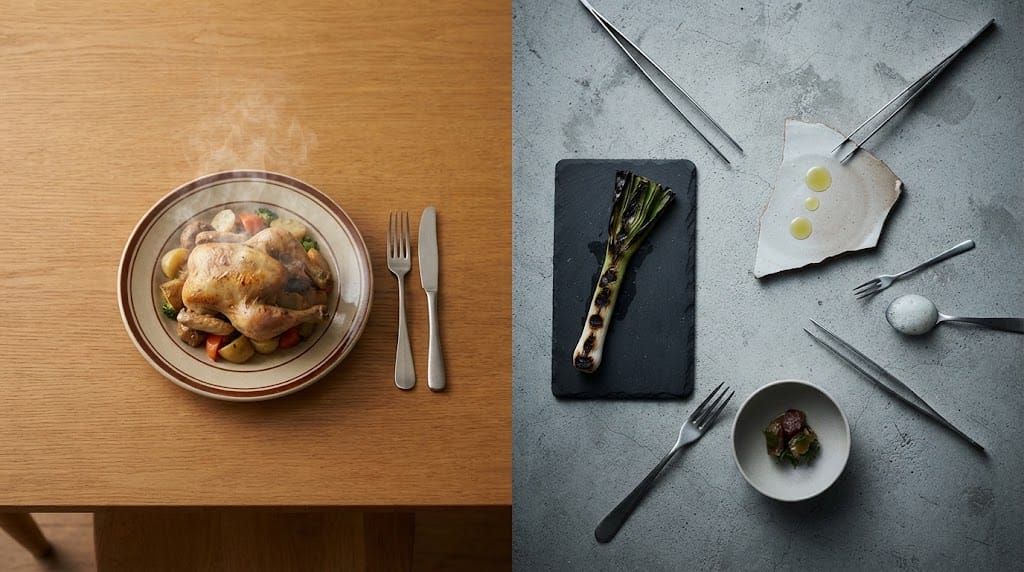
How We Traded Flavor for Performance Art
There is a kind of modern restaurant experience that feels less like buying dinner and more like being a junior partner in a venture-capital startup you never wanted to join. You walk into a room that smells overwhelmingly of charred wood, high-end white paint, and the faint, unmistakable panic of people who are paying forty-eight dollars for four ounces of heritage pork belly.
The menu isn't a menu anymore. It’s a curated manifesto printed on heavy, off-white cardstock that feels like expensive watercolor paper. It has no categories. There are no headings like Appetizers or Entrees because classifying food by its utility is apparently too bourgeois for a Tuesday night in Brooklyn or Silver Lake or the trendy side of Grand Rapids. Instead, the server—a twenty-four-year-old with a vintage denim jacket and a vocabulary heavily informed by graduate-level cultural theory seminars—comes over and explains that the kitchen operates on a "small-plates, shareable framework designed to challenge how we think about proteins."
You nod. You always nod, because to push back is to mark yourself as an unevolved Neanderthal who still eats TGI Fridays potato skins in the dark.
What follows is an hour-long exercise in cognitive dissonance where four disparate items arrive at the table whenever the kitchen feels like sending them out. First comes a charred head of local cauliflower resting in a pool of cashew-miso emulsion, dusted with puffed quinoa. Twenty minutes later, right as you’ve finished scraping the last smear of nut paste off the stoneware, a solitary duck heart skewered on a piece of reclaimed iron lands next to your water glass. You are expected to eat it immediately, while the cauliflower is a distant memory and the third course—a plate of heirloom carrots that cost as much as a hardcover biography—is still hovering somewhere in the purgatory of the pass.
This is where we are now. We have successfully transformed eating—the most fundamentally animal, low-stakes biological necessity we possess—into an elaborate, highly stratified tier of cultural signaling.
Think about how bizarre this is. For the entirety of human history, food trends were driven by abundance or technology. You got the freezer, or the microwave, or the interstate highway system, and suddenly you could eat frozen fish sticks or microwave burritos or chain-restaurant blooming onions shaped like structural hazards. Those things were bad for you, sure, but they were honest about what they were. They were cheap, processed calories designed to maximize convenience and minimize friction.
Today’s food trends do the exact opposite. They are deliberately designed to maximize friction.
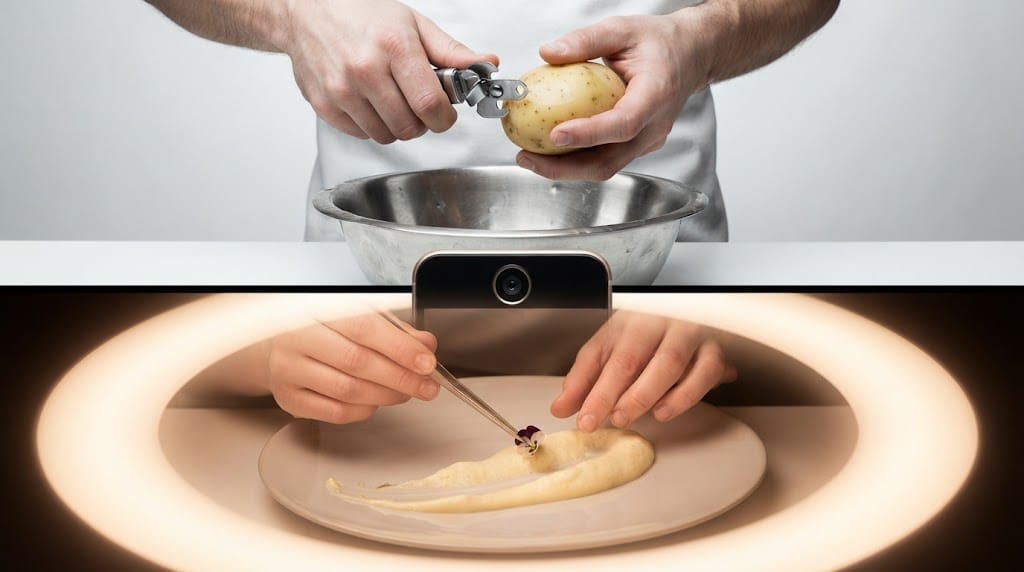
Take the current obsession with fermentation, which has mutated from a practical method of preserving winter root vegetables into an aggressive personality trait. You cannot exist in a metropolitan area right now without knowing someone who has a mason jar of bubbling, semi-putrid cabbage sitting on their kitchen counter like a science fair project gone rogue. They will talk to you about the microbiome with the evangelical fervor of a mid-level tech evangelist describing blockchain. They want you to taste their homemade sourdough discard crackers not because they taste good—let’s be entirely honest here, they usually taste like a stale saltine that survived a flood—but because the act of eating them proves that the person who made them possesses a hyper-specific kind of moral and aesthetic discipline.
It’s all about curation. We don’t consume food anymore; we consume the narrative architecture surrounding the food.
Every single bite has to have a provenance. If you order a chicken sandwich, you aren’t just getting poultry; you are getting a biographical sketch of a bird that lived a more emotionally fulfilling life than you ever will. The menu tells you the chicken was pasture-raised on a regenerative family farm in the Hudson Valley, where it was fed an organic diet of heirloom grains and listened to public radio. By the time you take a bite, you feel like a monster for chewing it, but you also feel like a better citizen of the planet because you paid seventeen dollars for a thigh on a brioche bun made by someone who identifies as a pastry anarchist.
And then, of course, there is the aestheticized ugliness of modern presentation. For a long time, food design was about symmetry and color. Now, we have entered the era of deliberate chaos. Everything is served on unglazed, matte-black ceramics or chunks of jagged slate that look like they were ripped out of a quarry by an angry geologist. Your food is arranged to look like it was accidentally dropped from a second-story window, then artfully rearranged by an interpretive dancer. There are swooshes of beet reduction that look like crime scene evidence. There are edible flowers scattered across your polenta like confetti at a depressing party.
Why do we do this? Because in an era where literally everything can be photographed, filtered, and beamed to thousands of strangers in zero point four seconds, the primary function of a meal is no longer to provide caloric energy. Its primary function is to act as a placeholder for your identity.
If you post a picture of a steaming plate of beef stroganoff from a roadside diner, what does that say about you? It says you’re basic. It says you lack imagination. It says you might vote the wrong way or listen to terrestrial radio. But if you post a photograph of a single charred leek resting on a smear of ash-infused labneh, with three drops of cold-pressed perilla oil gleaming under the ring light of your iPhone—well, now you’re saying something. You’re saying: I understand the current cultural moment. I am paying attention. I am sophisticated enough to appreciate things that taste faintly of dirt and smoke if they come with the right pedigree.
We have traded flavor for intellectualized discomfort.
Consider the obsession with extreme spice—the whole Hot Ones cinematic universe where famous actors cry into chicken wings coated in battery acid. We’ve turned eating into an endurance sport. The goal isn’t to enjoy the meal; the goal is to survive it, to prove that your nervous system can handle a level of synthetic pain that would have incapacitated a nineteenth-century sea captain. We are constantly seeking out culinary experiences that punch us in the face just so we can feel something—anything—through the thick, insulating layer of digital numbness that covers modern life.
We want our food to be difficult. We want it to be scarce. We want it to require a two-month waitlist on Resy, executed precisely at nine a.m. on a Wednesday, using a browser extension that makes you feel like you’re hacking into the Pentagon just to secure a table at a place that serves small plates of charred cabbage.
And the irony—the great, sprawling, beautiful irony of it all—is that underneath all the tweezers, the fermentation chambers, the heritage grains, and the algorithmic hype, we are all just terrified, tired people who secretly want to eat a gas-station Slim Jim while watching a nine-hour YouTube video about the 1994 New York Knicks.

We’ve built this impossibly elaborate, hyper-expensive cathedral of modern gastronomy, and we’re all sitting inside it, chewing on our ash-dusted root vegetables, pretending we’re having a transcendent spiritual experience when what we really want is just a piece of cheese that doesn't have a backstory. But we won't say it. We can't say it. Because as long as the lighting is moody and the soundtrack is obscure indie jazz from 1982, we will keep paying forty bucks for the privilege of being mildly disappointed by a turnip.