
The Hippie Infrastructure

There is a fifty-year-old belief about hippies that goes something like this: a bunch of stoned kids in tie-dye sat in muddy fields, thought they were changing the world, and then grew up to become investment bankers. This punchline has calcified into received wisdom across sitcoms, op-eds, and stand-up specials. Like most convenient lies, it survived through sheer repetition rather than actual scrutiny.
And it is almost entirely wrong.
It is not wrong because no hippies sold out; plenty did, just as plenty of people in every generation compromise their youthful ideals once the rent comes due. It is wrong because it completely misses what the counterculture actually left behind. When tallied honestly, the movement built much of the infrastructure of our modern world.
Consider the environment. On April 22, 1970 twenty million Americans participated in the very first Earth Day. This was an almost unfathomable turnout for a coordinated day of environmental action, completely without precedent in American history. While mainstream politicians like Democratic Senator Gaylord Nelson drove the initiative, the sheer cultural appetite for questioning industrial civilization came directly from the counterculture wellspring that produced communes and back-to-the-land movements. For the first time, a generation asked whether infinite growth and infinite pollution were compatible with a livable planet.
The political pressure was too immense to ignore. Within months, President Richard Nixon – a man with zero natural sympathy for the counterculture—created the Environmental Protection Agency (EPA) by executive order. Major amendments to the Clean Air Act followed in 1971, and the Clean Water Act arrived a year later. None of this happens without the cultural shift forced into the mainstream mainstream by the counterculture. Hippies did not just complain about pollution in songs; they ignited the regulatory apparatus that still keeps American rivers from catching fire the way the Cuyahoga River literally had in 1969.
The same lineage applies to food and technology. The organic food movement, the farmers' market renaissance, and the modern obsession with agricultural transparency trace directly back to communal experiments in the late 1960s. These were practical attempts to disconnect from a chemically saturated food system. Decades later, this impulse commercialized into Whole Foods, CSA boxes, and neighborhood farm-to-table restaurants.
In technology, the connection is even more direct. Stewart Brand, a counterculture fixture who hung around Ken Kesey’s Merry Pranksters, began publishing the Whole Earth Catalog in 1968. This sprawling compendium of tools was built around personal access to information outside of institutional gatekeeping. Steve Jobs later described the catalog as a spiritual and intellectual blueprint for Apple—the then-radical idea that computing power should be personal, accessible, and liberating rather than locked inside corporate and government mainframes. The founding ethos of Silicon Valley runs straight back to a magazine assembled by a guy who dropped acid with the Grateful Dead’s road crew.
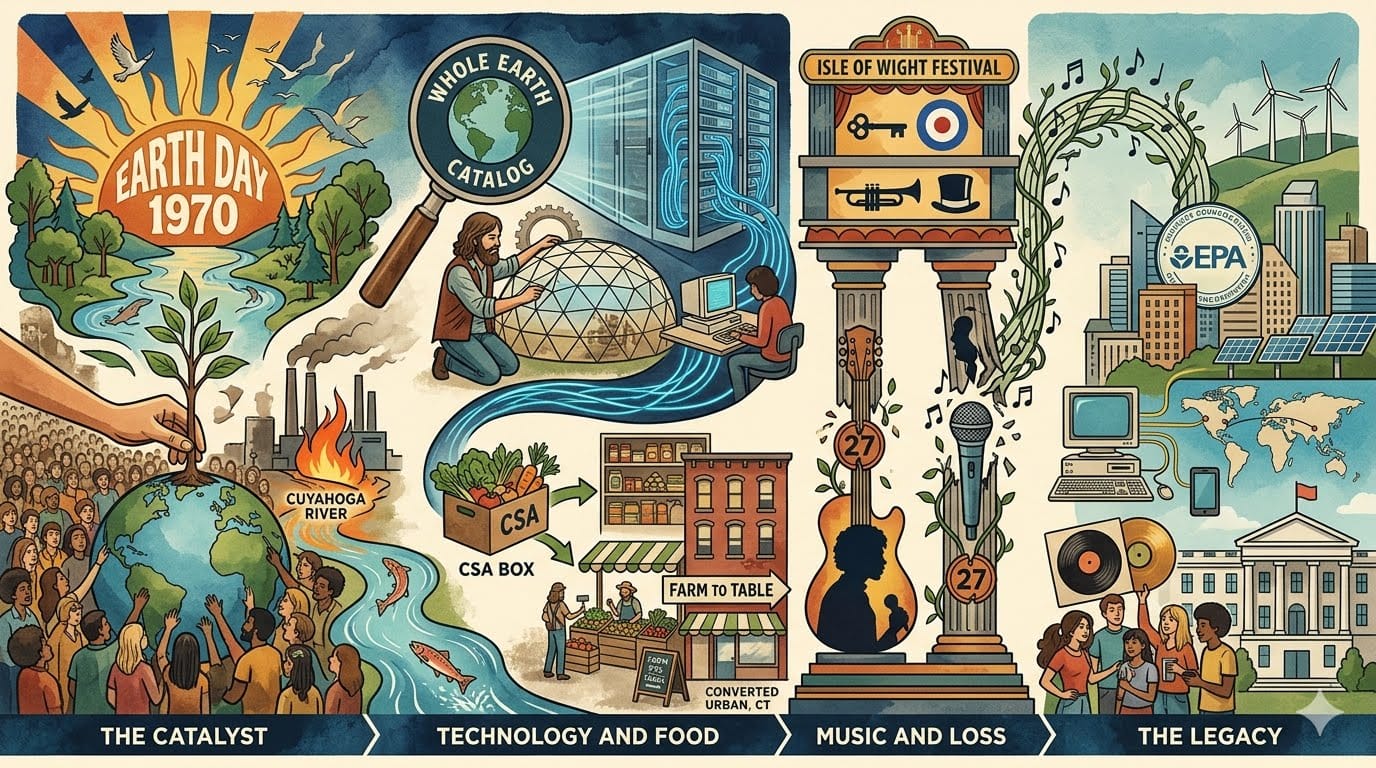
This movement reached its absolute apex of visible scale in the summer of 1970, right before the mainstream media began writing its obituary. From August 26 through 30, roughly 600,000 people descended on the Isle of Wight Festival off the southern coast of England, creating the largest rock festival humanity had ever assembled. The lineup was comically stacked: the Doors, the Who, Miles Davis, Joan Baez, and Leonard Cohen. Somewhere in the middle of that staggering bill was Jimi Hendrix, giving a restless, brilliant performance. Three weeks later, he was dead.
The counterculture’s largest gathering and one of its brightest individual flames collided in the same handful of days. This tension defines the era. The movement’s idealism was not naive theater; it produced lasting institutions, public policy, and permanent shifts in how we view war, ecology, and personal freedom.
Yet, 1970 was also the year the movement's internal seeds of unraveling fully sprouted. Charles Manson, who had drifted through the Los Angeles counterculture scene, released an album from jail that March to fund his murder defense. The same openness and rejection of conventional authority that produced genuine liberation also left the movement dangerously exposed to exploitation by monsters.
Simultaneously, the unforgiving arithmetic of drug abuse began killing the movement's most talented children. Hendrix died in September; Janis Joplin followed in October. Both were only twenty-seven years old. The same culture that gave the world Sgt. Pepper and the sonic vocabulary of psychedelia was suddenly attending funeral after funeral for the architects of that vocabulary.
The honest, unsentimental truth is that the hippies neither totally failed nor totally succeeded. Their utopian vision of a completely remade world did not materialize. Instead, a radical cultural experiment ran its course over a decade, burned out its most brilliant participants, attracted exploiters, and still managed to leave behind the modern environmental movement, a food renaissance, a personal-computing ethos, a permanently skeptical relationship with government authority, and an enduring body of music.
By the autumn of 1970, the first great wave was visibly cresting. But the infrastructure it built kept right on working quietly for decades after the tie-dye went out of fashion. The lazy joke about hippies becoming investment bankers misses a much stranger truth: some of them became regulators, some became engineers, and some just kept making music that outlasted everyone who dismissed them as a phase.
Tomorrow, the movies nobody expected.
Tim
Tim Lowe is a writer, book expert, retired sailor, retail worker, and renaissance man.
He is currently traveling the country and working on his forthcoming book.