
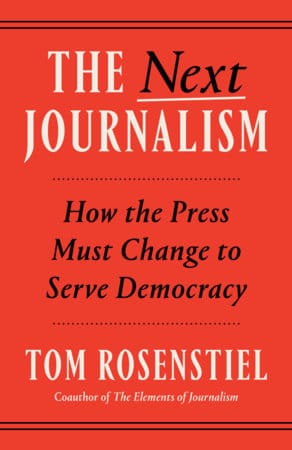
The Next Journalism


How the Press Must Change to Serve Democracy
To understand the current decay of American journalism, we must look beyond the standard lamentations of the political and economic establishment. The dominant narrative offered by media executives and mainstream commentators is one of technological victimhood. They tell us that the press is dying simply because the internet broke the traditional advertising model, or because the public has grown inexplicably cynical, lazy, and polarized. But this explanation is a convenient evasion. It hides a deeper, more uncomfortable truth that has defined the American experience from the Alien and Sedition Acts to the corporate media monopolies of our own time: the crisis in journalism is, at its core, a crisis of American democracy itself.
When the elite institutions of a society lose their moral authority, the mechanisms they use to control and distribute information inevitably begin to shatter. Today, faith in news outlets has dwindled to historic lows. Vast swathes of the country have become "news deserts," entirely abandoned by the national conversation. Audiences are actively turning away from coverage that is deliberately alarmist, hyper-partisan, and hopelessly fragmented. This is not a collective psychological failure by ordinary citizens; it is a rational withdrawal from a system that no longer serves them. The corporate press has long functioned as an echo chamber for the powerful, prioritizing the theater of partisan squabbling over the lived realities of working-class people, marginalized communities, and the systemic injustices embedded in our society.
It is precisely within these historical currents that Tom Rosenstiel’s vital new book, The Next Journalism, arrives. Rosenstiel—a veteran journalist, researcher, and co-author of the landmark text The Elements of Journalism—refuses to accept the shallow consensus that journalism’s collapse is merely a financial or technological problem. Instead, he makes a profound and necessary intervention: the roots of journalism’s failure are intellectual. The press did not just lose its money; it lost its mind, its purpose, and its democratic soul. It allowed itself to be governed by an ideology that treats information as a top-down commodity to be sold, rather than a bottom-up democratic utility to be shared.
For decades, the standard model of journalism has operated on a paternalistic premise. Elite editors and detached reporters decided from on high what constituted "news," packaged it into a static product, and delivered it to a passive audience. This model was designed to manufacture consent, not to foster critical consciousness or community power. In The Next Journalism, Rosenstiel outlines ten fundamental ways that journalism must completely transform if it is to become useful, trustworthy, and genuinely collaborative with the communities it is meant to serve.
The most revolutionary shift Rosenstiel calls for is the urgent need to redefine news as a service rather than a product. To a historian of popular struggles, this distinction is everything. A product is something manufactured by a corporation to extract profit from a consumer; it leaves the consumer isolated and passive. A service, however, is a relational and democratic act. When journalism is practiced as a service, its primary objective is not to maximize clicks or attract affluent demographics for advertisers. Its objective is to equip ordinary citizens with the tools, the historical context, and the verifiable truths they need to confront power, organize their neighborhoods, and govern their own lives.
Furthermore, Rosenstiel argues that the press must fully embrace a culture of radical transparency. For too long, mainstream journalism has hidden behind a false, weaponized standard of "objectivity"—a standard that historically meant uncritically transcribing the statements of government officials, military generals, and corporate spokespeople while ignoring the voices of dissidents, labor strikes, and civil rights activists. True trust cannot be built on the illusion of a neutral, omniscient narrator. It can only be built when journalists are transparent about their methods, their sources, their biases, and their intentions. By opening up the journalistic process to the public, The Next Journalism shows how reporters can strip away the mystique of elite expertise and invite the community into a shared search for truth.

This intellectual renewal is especially urgent as we enter the era of artificial intelligence. In the hands of unchecked corporate monopolies, AI threatens to completely automate the alienation of the public, flooding our cultural ecosystem with cheap, synthetic, and manipulative content designed to keep people distracted and divided. But Rosenstiel does not merely throw his hands up in despair. He provides a forward-looking, practical framework for how journalists can harness AI responsibly. Instead of using technology to replace human empathy and grassroots reporting, the press must use these new tools to deepen their investigation of complex systems and better distribute meaningful knowledge to the people who need it most.
Rosenstiel anchors his arguments in rich case studies and sharp historical insight, offering a roadmap that is as practical as it is bold. He recognizes that democracy cannot survive if the press continues to alienate the very people it relies upon for its legitimacy. The survival of our democratic experiment in the twenty-first century will not be secured by maintaining the status quo or by longing for a mythical "golden age" of mid-century network television news—an age that was itself deeply exclusionary. It will be secured by a press that actively aligns itself with the democratic aspirations of ordinary people.
The Next Journalism is an indispensable text for journalists who are weary of serving a broken system, for policymakers who recognize the systemic dangers of information starvation, and for everyday readers who refuse to surrender their right to a truthful world. Tom Rosenstiel has not just written a book about media theory; he has written a manual for democratic reconstruction. If we are to dismantle the structures of apathy and oppression that dominate our current political landscape, we must begin by reclaiming the stories we tell about ourselves. This book shows us exactly how to start.