
The Night Before

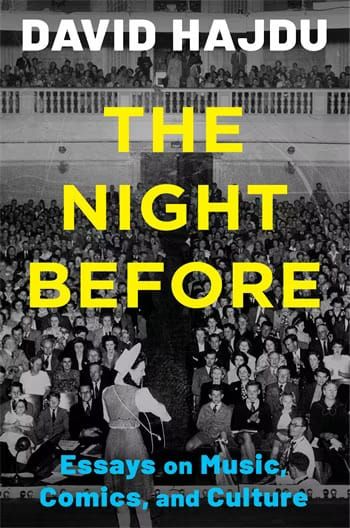
In an era defined by algorithmic playlists and rapid-fire digital scrolling, true cultural discernment feels rarer, and more vital, than ever. For more than thirty years, acclaimed critic and cultural historian David Hajdu has served as an indispensable guide through the sprawling landscape of American art, casting fresh light on artists both legendary and overlooked, and bridging the divide between high art and popular entertainment. With The Night Before: Essays on Music, Comics, and Culture, published by Columbia University Press, Hajdu gathers three decades of his sharpest, most illuminating essays into a vibrant, wide-ranging volume that invites readers to see—and hear—familiar culture with brand-new ears.
Drawing largely from his celebrated work for The New Republic and The Nation, The Night Before operates on a captivating premise: that art does not move along a neat, one-way timeline. Instead, Hajdu likens the currents of culture to the Hudson River, a subject of his own personal fascination, whose tidal waters famously flow in both directions. Across these pages, past, present, and future are locked in a continuous, dynamic dialogue.
That sweeping historical perspective allows Hajdu to connect dots few other critics would dare attempt. In a single volume, he moves seamlessly from the searing cries for racial justice by the pioneering "blues queens" of the 1920s to the cutting-edge studio technologies shaping twenty-first-century pop hits—spanning a century of vocal innovation from Billie Holiday to Billie Eilish. With piercing yet lively prose, Hajdu examines how three generations of women singers upended gendered expectations, traces the often-overlooked racially mixed roots of country music, and explores everything from the intricate harmonies of Bulgarian folk music to the radical adventurism of jazz bassist William Parker and the hook-heavy pop craft of Adele. Even icons we assume have been analyzed to exhaustion—like Bob Dylan, Tony Bennett, and the Beatles (including a standout deep dive into their delightfully eccentric track "You Know My Name")—emerge newly vital under his scrutiny.
Crucially, Hajdu’s insatiable curiosity extends far beyond the turntable. A lifelong devotee of sequential art, he devotes generous attention to the shifting boundary between what was once dismissed as "junky" lowbrow entertainment and what is now revered as serious art. Readers are treated to incisive explorations of graphic novelists and cartoonists like Roz Chast, Art Spiegelman, Adrian Tomine, and Daniel Clowes, alongside a fascinating look back at the unhinged early comic strip that quietly foreshadowed Charles Schulz’s Peanuts.
While Hajdu’s critical eye is razor-sharp, The Night Before is equally powered by warmth, wit, and personal reflection. Having grown up as an aspiring rocker in suburban New Jersey before immersing himself in the mid-1970s New York City scene—witnessing bands like Talking Heads at CBGB while discovering the city’s vibrant jazz underground—Hajdu writes as both an authoritative historian and an unabashed fan. In the book’s deeply personal closing essays, he turns his gaze inward, meditating on the tidal pull of the Hudson River, the mystery of a marked-up secondhand copy of Invisible Man, and a comic collaboration with illustrator John Carey chronicling Bradley's, a beloved New York jazz haunt.
Early critical praise confirms that The Night Before is a triumph of the essayist's craft. Kirkus Reviews, in a starred review, hailed the collection as "a pleasure to read: sharp yet generous assessments of artists and their art," while the Boston Globe called it "the perfect book to dip into for an instant rejuvenation of the weary, jaded brain". Cultural historian John Gennari praises Hajdu as a "cultural omnivore" whose wisdom has never been more necessary in our age of digital onslaught, and author James Marcus notes that the book "does what the best criticism is supposed to do," taking artists we think we know inside and out and making us see them anew.
Few writers are better equipped to map these cultural crossroads. A professor at the Columbia Journalism School, David Hajdu is a five-time winner of the ASCAP/Deems Taylor Award for Music Writing—most recently honored for A Revolution in Three Acts: The Radical Vaudeville of Bert Williams, Eva Tanguay, and Julian Eltinge—and the author of Lush Life, his landmark biography of Billy Strayhorn, named one of the hundred best nonfiction books of all time by the New York Times.
Whether you are a devoted music obsessive, a comics aficionado, or simply a curious reader eager to understand how yesterday’s rebels become today’s classics, The Night Before is an exhilarating companion—proof that the conversation between past and present is far from over.
-30-