
The Year Rock Music Grew Up and Never Looked Back

Look, I know I made an aggressive, line-in-the-sand case for 1970 being the single greatest year in the history of recorded music. I stand by every single word of it.
But I need to be brutally honest with you about something. It’s a bit uncomfortable for the thesis of this series, but here it is: 1971 might actually be better.
Now, 1970 was more foundational. It laid the groundwork, cracked the genre boundaries wide open, and gave everyone permission to get serious. But 1971 is where that permission got cashed in at the absolute highest level of craft. The sheer density of masterpiece albums released in that single twelve-month stretch is, quite frankly, faintly ridiculous to even type out.
Let's look at the raw, undeniable evidence from that year:
- Marvin Gaye – What's Going On (May): The single most important soul album ever made. Motown's Berry Gordy initially refused to release it because it was "too political and too depressing." Gaye pushed back, threatening to never record for Motown again unless it was released exactly as he envisioned it—a masterpiece tackling police brutality, environmental collapse, and poverty. It became one of the best-selling, most critically important records in Motown history. That’s 1971 in miniature: an artist fighting a safe commercial apparatus and winning.
- Led Zeppelin – IV (November): The untitled fourth album that everyone just calls IV or Zoso. Home to "Stairway to Heaven"—eight extraordinary minutes of music before it was absorbed into the culture as a classic-rock cliché.
- The Who – Who's Next (August): Built out of the wreckage of Pete Townshend's abandoned, absurdly ambitious Lifehouse project. It gave us "Baba O'Riley" and "Won't Get Fooled Again." That furious, weary climax lyric—"meet the new boss, same as the old boss"—was the most prophetic line of the entire decade right before Watergate proved it true.
- Carole King – Tapestry (February): After years as an uncredited hitmaker for other stars, King stepped into the spotlight and effectively invented the commercial template for the confessional singer-songwriter album that dominated the rest of the decade.
- Joni Mitchell – Blue (June): A nakedly, unflinchingly personal record about heartbreak and loneliness. Fifty-plus years later, it remains the gold standard that other songwriters cite when they want to explain what genuine emotional honesty sounds like.
- David Bowie – Hunky Dory (December): Quietly assembling the persona and songwriting muscle that would explode into Ziggy Stardust the very next year.
- Sly and the Family Stone – There's a Riot Goin' On (November): A murky, paranoid, deliberately unpolished document of a man and a movement curdling under the weight of drugs and the collapse of the utopian sixties.
- The Rolling Stones – Sticky Fingers (April): Featuring the Warhol-designed zipper cover and the lethal one-two punch of "Brown Sugar" and "Sway." Many critics still consider it the high-water mark of their entire catalog.
I could keep going. Curtis Mayfield’s Super Fly soundtrack. The Doors’ L.A. Woman. John Lennon’s Imagine. The list is relentless.
What is truly remarkable when you listen back across 1971 is how consistently these records refuse easy comfort. They are drop-dead gorgeous, but they are also documents of genuine despair, isolation, and identity crises.
If 1970 taught popular music that honesty was possible, 1971 is where the format fully matured. It proved you could hold that honesty at the absolute highest level of songwriting and production craft without sacrificing a single ounce of emotional truth for the sake of polish.
But that maturity came with a dark, heavy price.
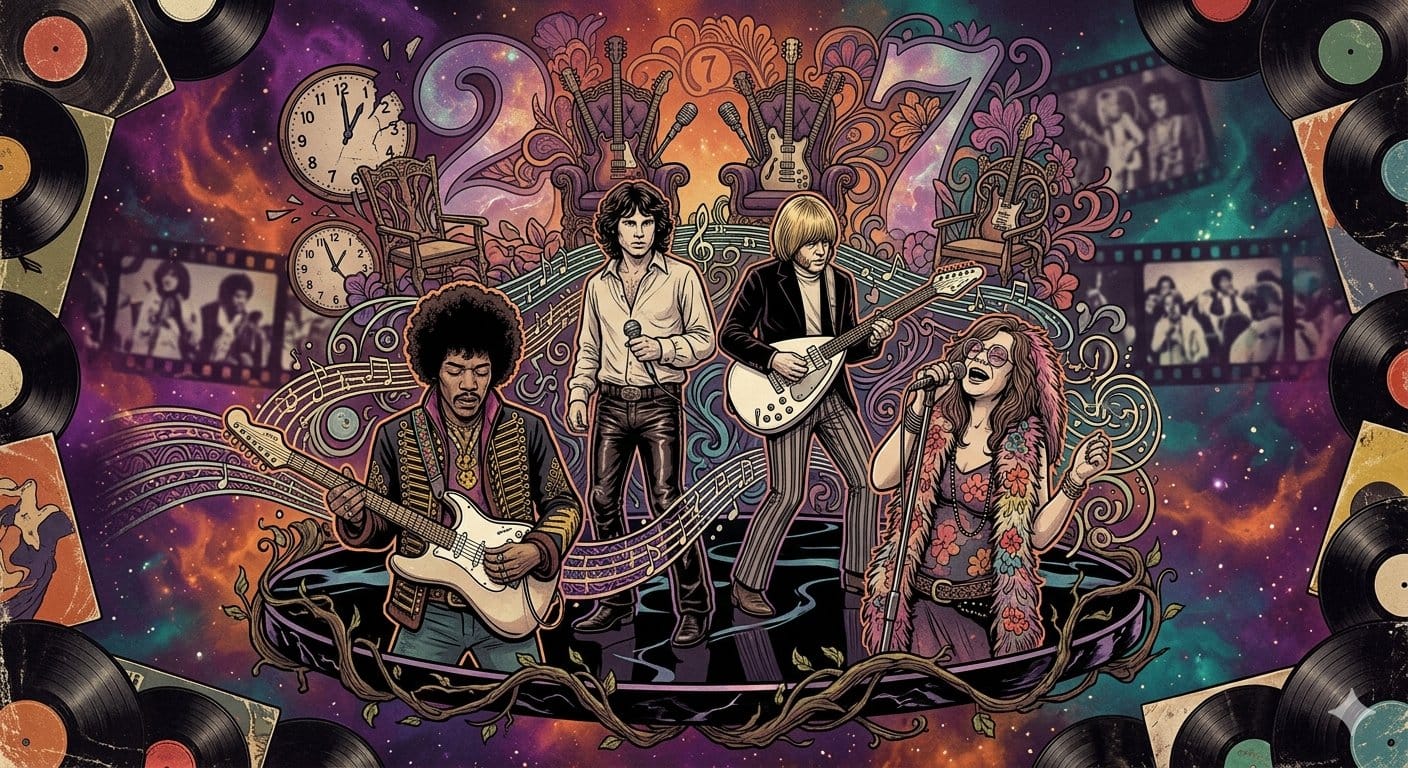
On July 3, 1971, Jim Morrison died in a Paris bathtub at just 27 years old. He joined Jimi Hendrix and Janis Joplin in a grim mathematical club the culture was already keeping against its will. Three of the era's most electric performers, completely gone within ten months of each other, all at the exact same devastating age 0f 27.
I’ll deal with what Morrison's death actually meant—and how the year’s films got considerably more paranoid and morally unresolved as Watergate began to unfold—in the very next segment. Stay tuned.
Tim
Tim Lowe is a writer, book expert, retired sailor, retail worker, and renaissance man.
He is currently traveling the country and working on his forthcoming book.