
Tim Curry (1946-2026)

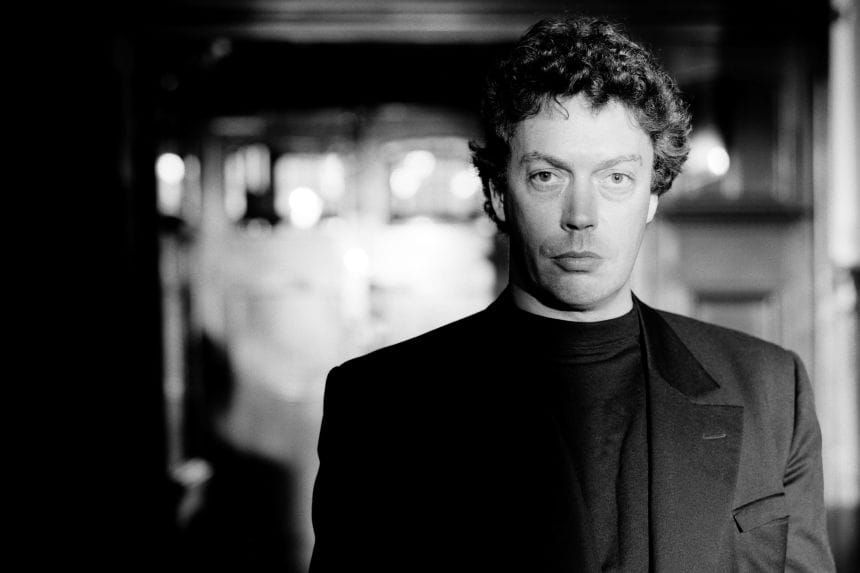
Tim Curry was never supposed to be real. He was an elaborate prank pulled on the collective consciousness of the 1970s, a theoretical creature engineered in a damp basement by someone who decided that rock and roll, Gothic literature, and high camp needed to be filtered through the vocal cords of an opera singer who had smoked two packs of unfiltered cigarettes a day since the age of nine.
When you encounter him for the first time—usually around age eleven, while your parents are asleep and cable television has devolved into the strange, glowing static of the post-midnight hours—he feels like an unauthorized transmission. He wasn’t acting. Acting implies a boundary between the person and the role, a professional distance where the guy playing the heavy takes off his makeup, goes home to Studio City, and worries about his dry cleaning. Tim Curry never went home. He inhabited a permanent, velvet-draped dimension where every room was dimly lit, perpetually smelled of ozone and cheap gin, and required everyone present to acknowledge that the universe is fundamentally absurd.
It is easy to categorize him through his villains, because pop culture loves a villain the way a tourist loves an overpriced postcard. We remember the voice that rolled around in our skulls when we watched FernGully, or the way he made a six-foot-tall red-skinned demon in Legend feel strangely approachable, like an avant-garde landlord who only wants your rent in vintage vinyl and blood sacrifices. We remember him as Wadsworth in Clue, sprinting down a hallway with the manic, mathematical precision of a man trying to explain a complex geopolitical crisis using only a dessert spoon and three different dialects of British English.
And, of course, there is The Rocky Horror Picture Show. It is impossible to overstate how much heavy lifting that single performance did for the collective psyche of anyone who grew up feeling slightly out of alignment with the suburbs. Before Dr. Frank-N-Furter, deviance on screen was usually punished by the script; it was code for tragedy or moral failure. But Curry walked out in fishnets, heavy eye makeup, and a posture that suggested he was simultaneously above and deeply amused by your entire lineage, and he completely broke the circuit board. He wasn't a cautionary tale. He was the main event. He sang about being a sweet transvestite from Transsexual, Transylvania with the unbothered, stadium-filling confidence of Freddie Mercury crossed with Oscar Wilde. He made weirdness look like the only sensible career path.
Yet reducing him to camp—or even to the rogue's gallery of late-twentieth-century cinema—misses the actual part of what made him fascinating. Tim Curry was essentially a character actor trapped in the body of a rock star who had accidentally been handed the script to a classic English novel. He possessed an almost pathological commitment to whatever ridiculous set he was standing on. Whether he was playing a psychotic hotel concierge terrorizing a ten-year-old Kevin McCallister in New York City or a Shakespearean foil on a London stage, he attacked every syllable like it was the last piece of oxygen left in the room. He chewed the scenery, but he did it with such architectural precision that the scenery actually looked better for having been devoured.
We live in an era now where everyone is trying very hard to be curated. People spend years cultivating a personal brand that is safe, digestible, and optimized for algorithms. Tim Curry was the exact opposite of an algorithm. He was an analog anomaly—a glorious, unpredictable collection of sharp angles, arched eyebrows, and a laugh that sounded like an aristocrat choking on a pocket watch. Even after a stroke in 2012 quietly removed him from the physical hustle of movie sets, his voice remained a permanent fixture of our cultural background radiation. You could hear him coming a mile away, and the world was always slightly more interesting the second he started speaking.
He leaves behind a pop-cultural footprint that is impossible to replicate because nobody else is ever going to have that specific cocktail of Royal Shakespeare Company training and smoky, subterranean decadence. He didn't just play characters; he colonized them. And now that he is gone, the culture is left a little quieter, a little more beige, and infinitely less fun. We are left in a world that takes itself far too seriously, trying to figure out how to navigate the dark without the guy in the corset to show us where the light switches were.